L'océan Pacifique se réchauffe à nouveau — et cette fois, le signal est exceptionnellement fort.
Selon la dernière mise à jour de l'Organisation météorologique mondiale (OMM), l'événement El Niño de 2026 continue de se renforcer et devrait atteindre son pic vers décembre 2026.
La prévision est particulièrement significative : l'anomalie de température de surface de la mer Niño 3.4 devrait atteindre environ +3,7 °C entre octobre et décembre 2026, dépassant potentiellement le précédent record observé de +2,6 °C en 2015-2016. L'OMM prévoit également une probabilité quasi 100% qu'El Niño persiste jusqu'en février 2027.
Pour les habitants des régions insulaires et côtières, il s'agit de bien plus qu'un titre d'actualité climatique.
C'est un rappel que les bâtiments doivent être conçus pour l'environnement auquel ils sont réellement confrontés.
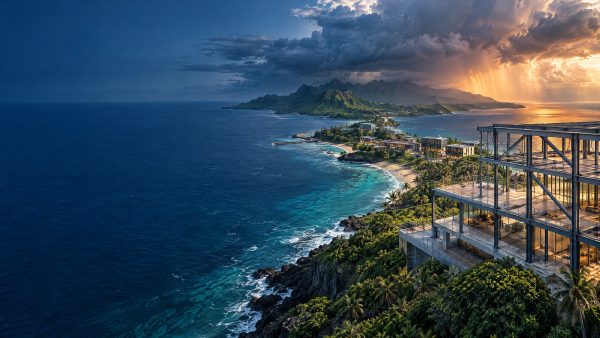
El Niño fort en 2026 : Pourquoi la résilience climatique est importante pour les bâtiments insulaires et côtiers
1. Pourquoi El Niño 2026 est-il différent ?
El Niño est un phénomène climatique naturel associé à des températures de surface de la mer inhabituellement chaudes dans le Pacifique tropical central et oriental.
Mais l'événement actuel attire une attention particulière en raison de son intensité.
L'OMM rapporte que l'indice Niño 3.4 est passé d'environ +1,6 °C au-dessus de la normale en juin 2026 à +2,5 °C en août, la moyenne saisonnière devant atteindre approximativement +3,7 °C entre octobre et décembre 2026.
Les conséquences ne se limitent pas à l'océan Pacifique.
Les événements El Niño intenses peuvent modifier les schémas de précipitations et de températures à grande échelle dans le monde entier, augmentant la probabilité de :
- Chaleur extrême
- Fortes précipitations
- Inondations
- Sécheresse
- Modification des schémas orageux
- Stress environnemental côtier
- Pression accrue sur les infrastructures
Il est important de noter qu'El Niño ne signifie pas que chaque île connaîtra automatiquement davantage d'ouragans ou de cyclones. Son influence varie considérablement selon les régions.
Mais cela signifie très clairement une chose :
Les conditions climatiques deviennent un facteur de plus en plus important dans la conception des bâtiments.
2. Pourquoi les bâtiments insulaires nécessitent davantage d’attention
Les bâtiments situés sur les îles et dans les zones côtières sont exposés à une combinaison de conditions environnementales auxquelles les bâtiments situés à l’intérieur des terres ne sont pas nécessairement confrontés avec la même intensité.
Prenons l’exemple d’un projet côtier classique.
Il peut être exposé à :
Vents forts + forte humidité + air chargé de sel + fortes pluies + ensoleillement intense + embruns marins
Et ces facteurs agissent souvent de concert.
Un bâtiment situé près de l’océan ne doit pas seulement résister aux charges structurelles.
Il doit également conserver ses performances au fil des années d’exposition.
Cela pose deux défis majeurs pour les bâtiments en acier :
Résistance au vent
Le système structurel doit être conçu pour transférer en toute sécurité les charges dues au vent depuis la toiture et les murs, à travers les poutres et les poteaux, jusqu’aux fondations.
Protection anticorrosion
Les éléments en acier, les assemblages et les fixations doivent être correctement protégés contre l’humidité, les embruns salins et l’exposition au milieu marin.
Pour un projet insulaire, ces deux exigences ne doivent pas être considérées comme des améliorations facultatives.
Elles doivent être intégrées à la réflexion dès le début de la conception.
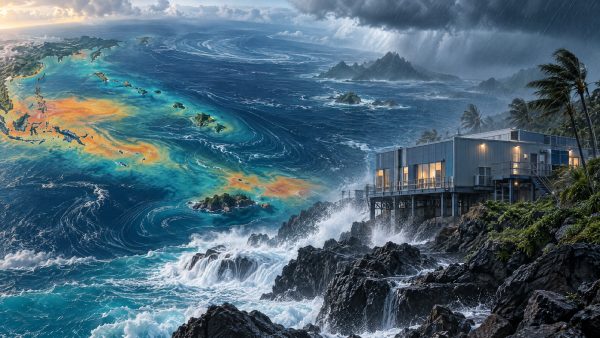
Face au changement climatique, les bâtiments insulaires doivent être préparés à l’évolution des conditions environnementales.
Lorsqu’on pense aux phénomènes météorologiques extrêmes, on pense généralement au vent.
But for steel structures in coastal areas, corrosion can be just as important.
Salt particles carried by marine air can settle on exposed steel surfaces and connection components.
Combined with:
- High humidity
- Rainfall
- Condensation
- Sea spray
- High temperatures
the environment can become particularly aggressive to unprotected steel.
And corrosion is not always obvious at first.
A steel frame may look strong from the outside while corrosion gradually affects smaller components such as:
- Boulons
- Anchor bolts
- Plaques de connexion
- Brackets
- Fasteners
- Welded areas
This is why anti-corrosion protection should not focus only on the main steel frame.
Every component matters.
4. Why Connections Matter During Strong Winds
A common misunderstanding is that wind resistance is simply about having “thicker steel.”
It is not that simple.
A building behaves as a complete structural system.
During strong winds, forces travel through multiple parts of the building:
Roof → Purlins → Beams → Columns → Connections → Anchor Bolts → Foundation
If one part of this load-transfer path is poorly designed, the performance of the entire system can be affected.
That is why wind-proofing requires attention to:
- Structural design
- Steel member sizing
- Roof design
- Connection details
- High-strength bolts
- Anchor bolts
- Bracing systems
- Foundation anchoring
For island and coastal projects, the question should therefore not simply be:
“How strong is the steel?”
A better question is:
“How does the entire building transfer wind loads safely to the foundation?”
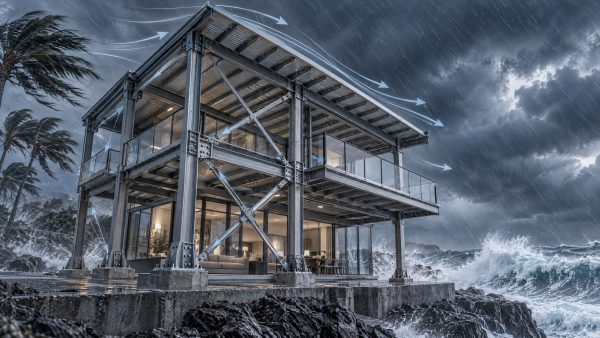
Wind-proofing is a complete structural system — from the roof to the foundation.
5. Why Prefabricated Steel Structures Are a Strong Choice for Island Projects
This is where prefabricated steel structures can provide a practical advantage.
Unlike traditional construction methods that depend heavily on extensive on-site fabrication, prefabricated steel buildings allow major structural components to be manufactured and inspected in a controlled factory environment.
For island projects, this can be especially valuable.
1. Controlled Manufacturing
Steel members and connection components can be manufactured according to engineering drawings and project specifications.
2. Faster Installation
A significant amount of fabrication can be completed before the materials arrive at the project site.
This can reduce the amount of on-site work required.
3. Better Quality Control
Factory inspection allows manufacturers to check:
- Material specifications
- Dimensions
- Soudage
- Bolt specifications
- Surface treatment
- Quantity
- Packaging
before shipment.
Steel structures can be customized for:
- Villas
- Resorts
- Staff accommodation
- Warehouses
- Bâtiments publics
- Commercial buildings
- Residential projects
5. Suitable for Remote Locations
For island projects where construction resources may be limited, prefabrication can help make logistics and installation more manageable.
6. Anti-Corrosion Protection: Small Components, Big Responsibility
For coastal projects, protecting the steel structure starts with understanding the environment.
Different projects may require different levels of corrosion protection depending on:
- Distance par rapport à la mer
- Salt exposure
- Humidity
- Rainfall
- Building location
- Durée de vie prévue
- Maintenance conditions
At Island Steel, anti-corrosion protection can include appropriate surface treatment systems such as galvanizing, spray coating and Dacromet treatment, depending on the component and project requirements.
For example, high-strength bolts and anchor bolts deserve particular attention because they are critical connection components.
A building may have thousands of steel components.
But the size of a component does not determine its importance.
A small bolt can have a very large responsibility.
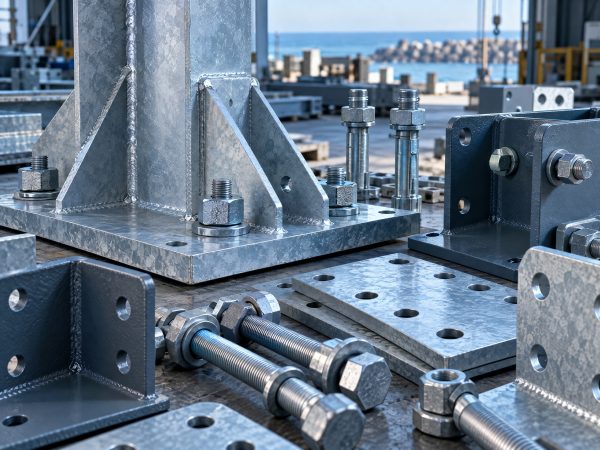
In coastal environments, corrosion protection must extend from the main frame to the smallest connection components.
7. La résilience climatique commence avant même que le conteneur ne quitte la Chine
Pour un projet sur une île isolée, résoudre un problème après l’expédition peut coûter cher.
Imaginez que vous découvriez qu’il manque plusieurs éléments de raccordement alors que le conteneur est déjà arrivé sur l’île.
Le problème ne relève alors plus simplement de l’usine.
Il peut nécessiter :
Production supplémentaire → expédition internationale → douane → transport intérieur → retard sur le chantier
C’est pourquoi le contrôle qualité avant expédition est extrêmement important.
Chez Island Steel, notre processus d’inspection peut comprendre :
Vérification des matériaux → inspection des produits → échantillonnage des lots → contrôle des quantités → inspection du traitement de surface → emballage → expédition
L’objectif est simple :
Identify problems before the products leave the factory — not after they arrive at the construction site.
8. El Niño Is a Reminder: Build for the Destination, Not Just the Drawing
A building design should never exist independently from its environment.
A steel structure designed for an inland location may face very different conditions from one built beside the ocean.
For island and coastal projects, engineers and project owners should consider questions such as:
What is the local wind design requirement?
What are the expected wind pressures and uplift forces?
How close is the building to the sea?
What level of corrosion exposure should be expected?
How will the steel connections be protected?
How are anchor bolts connected to the foundation?
What happens if maintenance access is limited?
These questions become even more important when extreme weather and climate variability are part of the project’s long-term operating environment.
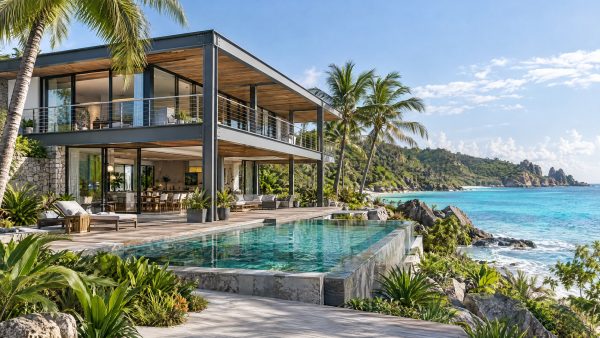
Designed for the destination: modern steel buildings engineered for island and coastal environments.
9. From El Niño to the Future of Island Construction
The 2026 El Niño event is not simply another weather story.
It is part of a larger conversation about how infrastructure should respond to changing environmental risks.
WMO’s latest outlook indicates that El Niño is expected to continue influencing temperature and rainfall patterns into early 2027.
For island nations and coastal communities, this raises an important question:
Are we still building only for today’s conditions?
Or are we building for the conditions a building may experience over the next 20, 30 or 50 years?
The answer can influence everything from material selection to structural design and corrosion protection.
10. Island Steel: Building for Wind, Salt and the Future
Chez Island Steel, our focus is not simply exporting steel components.
Our focus is providing prefabricated steel structure solutions for island and coastal environments.
We pay particular attention to:
Wind-Proofing
Structural systems designed with wind loads, connections and anchoring in mind.
Anti-Corrosion
Protection strategies designed around humid and marine environments.
Material Verification
Checking actual materials and components rather than relying only on appearance or paperwork.
Connection Quality
High-strength bolts, anchor bolts and connection components are treated as critical parts of the structural system.
Factory Quality Control
Inspection before products are packed and shipped overseas.
Prefabricated Construction
Manufacturing major components in the factory before transportation to the project location.
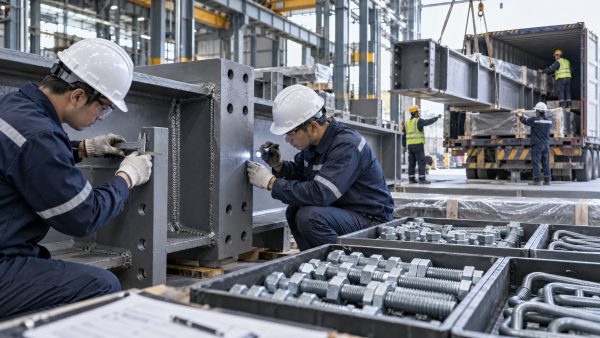
Quality starts in the factory — long before the steel structure reaches the island.
11. The Real Lesson of Super El Niño 2026
The biggest lesson may not be about El Niño itself.
It is about preparedness.
Climate conditions can change.
Storm patterns can change.
Rainfall can change.
Coastal environments can become more demanding.
But a building can be designed with these challenges in mind.
For island and coastal construction, this means thinking beyond the appearance of the finished building.
It means asking:
Can the structure withstand the expected wind loads?
Can the materials handle the local environment?
Are the connections reliable?
Is corrosion protection appropriate?
Can the building be efficiently manufactured, shipped and installed?
These are the questions that turn a building from simply “prefabricated” into a climate-conscious building solution.
Stronger Buildings. Safer Islands.
The strengthening 2026 El Niño is another reminder that environmental conditions should be considered before construction begins — especially for island and coastal projects.
For these environments, wind-proofing and anti-corrosion protection are not just selling points. They are fundamental considerations for long-term building performance.
At Island Steel, we believe that quality begins with every component.
From the main steel frame to the smallest bolt.
From material verification to surface treatment.
From factory inspection to container loading.
Every component matters.
Every batch matters.
Every project matters.
Island Steel
Professional Prefabricated Steel Structure Solutions for Island & Coastal Environments.
Planning an island, coastal or hurricane/cyclone-prone project?
Send us your site plan, architectural drawings or preliminary layout.
Our team can review the project requirements and discuss a suitable steel structure solution for your location.
FAQ
Quel est l'impact d'El Niño 2026 sur les bâtiments insulaires et côtiers ?
El Niño peut influencer la température mondiale, les précipitations et les conditions météorologiques régionales. Pour les bâtiments insulaires et côtiers, les maîtres d'ouvrage doivent considérer les risques potentiels tels que la chaleur extrême, les fortes pluies, les inondations et l'évolution des conditions de tempête. Une conception structurelle appropriée, des calculs de charge au vent et une protection anticorrosion peuvent contribuer à améliorer la résilience des bâtiments.
Comment concevoir des bâtiments à structure en acier pour résister aux vents violents, cyclones et ouragans ?
Les bâtiments en acier résistants au vent nécessitent plus que de simples éléments en acier robustes. La conception doit tenir compte des vitesses de vent locales, des pressions de vent de calcul, du soulèvement de toiture, du contreventement structurel, de la résistance des assemblages, des boulons d'ancrage et de l'ancrage des fondations. Island Steel peut développer des solutions de structure en acier spécifiques au projet en fonction de l'emplacement, des plans et des exigences de conception applicables.
Comment protéger les structures en acier de la corrosion dans les zones côtières ?
Les structures en acier côtières nécessitent une protection anticorrosion adaptée à leurs conditions d'exposition, notamment l'humidité, les embruns salins et la distance par rapport à la mer. Selon le projet, les options de protection peuvent inclure la galvanisation à chaud, des revêtements de protection appropriés et un traitement Dacromet pour les composants applicables. Le système approprié doit être sélectionné en fonction du composant, des spécifications du projet et de l'environnement de service attendu.
Comment puis-je obtenir un devis pour un projet de structure en acier côtière ?
Pour recevoir un devis spécifique à votre projet de la part d'Island Steel, veuillez fournir la localisation de votre projet, les plans architecturaux ou l'implantation préliminaire, les dimensions du bâtiment, l'usage prévu et toute exigence connue en matière de charge au vent ou de protection contre la corrosion. Notre équipe peut examiner vos informations et discuter d'une solution de structure en acier préfabriqué adaptée à votre projet.


 09 octobre 2026