El océano Pacífico se está calentando nuevamente, y esta vez la señal es inusualmente fuerte.
Según la última actualización de la Organización Meteorológica Mundial (OMM), el evento de El Niño de 2026 continúa fortaleciéndose y se espera que alcance su punto máximo alrededor de diciembre de 2026.
El pronóstico es particularmente significativo: se espera que la anomalía de temperatura de la superficie del mar en la región Niño 3.4 alcance aproximadamente +3.7°C durante octubre–diciembre de 2026, potencialmente superando el récord observado anterior de +2.6°C en 2015–2016. OMM también pronostica una probabilidad cercana al 100% de que El Niño persista hasta febrero de 2027.
Para las personas que viven en regiones insulares y costeras, esto es más que un titular climático.
Es un recordatorio de que los edificios deben diseñarse para el entorno que realmente enfrentan.
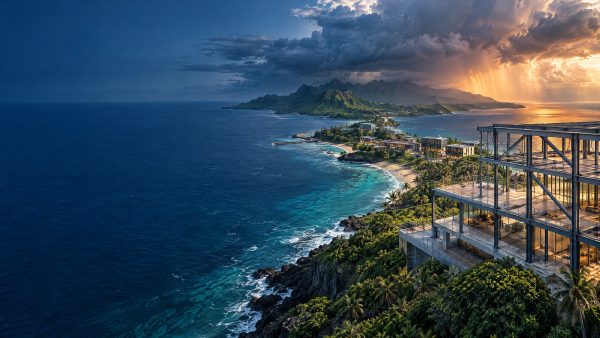
El Niño fuerte 2026: Por qué la resiliencia climática es importante para los edificios insulares y costeros
1. ¿Por qué es diferente El Niño 2026?
El Niño es un fenómeno climático natural asociado con temperaturas inusualmente cálidas en la superficie del mar en el Pacífico tropical central y oriental.
Pero el evento actual está atrayendo atención particular debido a su intensidad.
La OMM informa que el índice Niño 3.4 aumentó de alrededor de +1,6 °C por encima de lo normal en junio de 2026 a +2,5 °C en agosto, con un promedio estacional que se prevé alcance aproximadamente +3.7°C durante octubre–diciembre de 2026.
Las consecuencias no se limitan al océano Pacífico.
Los eventos fuertes de El Niño pueden alterar los patrones de precipitación y temperatura a gran escala en todo el mundo, aumentando la probabilidad de:
- Calor extremo
- Lluvias intensas
- Inundaciones
- Sequía
- Cambios en los patrones de las tormentas
- Estrés ambiental costero
- Mayor presión sobre la infraestructura
Es importante señalar que El Niño no significa que todas las islas vayan a experimentar automáticamente más huracanes o ciclones. Su influencia varía considerablemente según la región.
Pero sí deja algo muy claro:
Las condiciones climáticas son un factor cada vez más importante en el diseño de edificios.
2. Por qué los edificios insulares necesitan más atención
Los edificios insulares y costeros están expuestos a una combinación de condiciones ambientales que quizá no afecten con la misma intensidad a los edificios del interior.
Pensemos en un proyecto costero típico.
Puede estar expuesto a:
Vientos fuertes + humedad elevada + aire cargado de sal + lluvias intensas + luz solar intensa + rocío marino
Y estos factores suelen actuar de forma conjunta.
Un edificio situado cerca del océano no solo debe soportar cargas estructurales.
También debe mantener su rendimiento tras años de exposición.
This creates two major challenges for steel buildings:
Wind-proofing
The structural system must be designed to transfer wind loads safely from the roof and walls through beams and columns and ultimately into the foundation.
Anti-corrosion
Steel components, connections and fasteners must be properly protected against moisture, salt spray and marine exposure.
For an island project, these two requirements should not be treated as optional upgrades.
They should be part of the design thinking from the beginning.
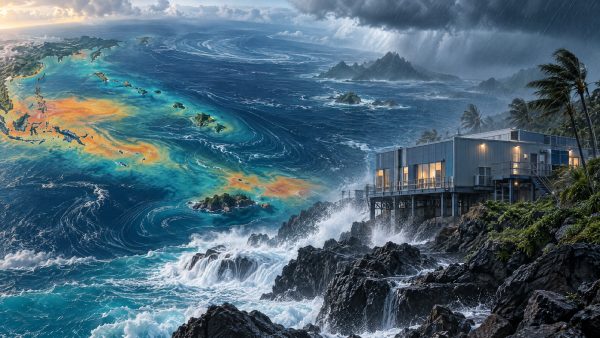
A changing climate means island buildings must be prepared for changing environmental conditions.
When people think about extreme weather, they usually think about wind.
But for steel structures in coastal areas, corrosion can be just as important.
Salt particles carried by marine air can settle on exposed steel surfaces and connection components.
Combined with:
- High humidity
- Rainfall
- Condensation
- Sea spray
- High temperatures
the environment can become particularly aggressive to unprotected steel.
And corrosion is not always obvious at first.
A steel frame may look strong from the outside while corrosion gradually affects smaller components such as:
- Pernos
- Anchor bolts
- Placas de conexión
- Brackets
- Fasteners
- Welded areas
This is why anti-corrosion protection should not focus only on the main steel frame.
Every component matters.
4. Why Connections Matter During Strong Winds
A common misunderstanding is that wind resistance is simply about having “thicker steel.”
No es tan sencillo.
Un edificio se comporta como un sistema estructural completo.
Durante los vientos fuertes, las fuerzas se transmiten a través de múltiples partes del edificio:
Cubierta → Correas → Vigas → Columnas → Conexiones → Pernos de anclaje → Cimentación
Si una parte de esta trayectoria de transferencia de cargas está mal diseñada, el rendimiento de todo el sistema puede verse afectado.
Por eso, para garantizar la resistencia al viento, es necesario prestar atención a:
- Diseño estructural
- Dimensionamiento de los elementos de acero
- Diseño de la cubierta
- Detalles de las conexiones
- High-strength bolts
- Anchor bolts
- Bracing systems
- Foundation anchoring
For island and coastal projects, the question should therefore not simply be:
“How strong is the steel?”
A better question is:
“How does the entire building transfer wind loads safely to the foundation?”
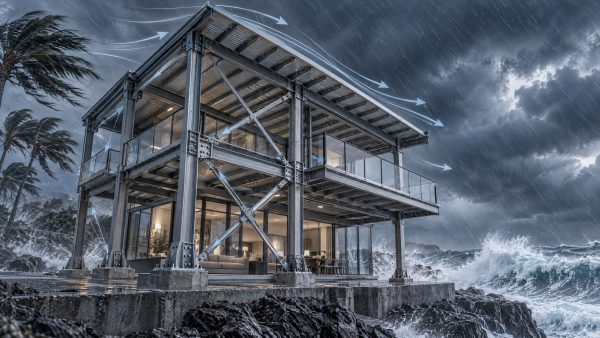
Wind-proofing is a complete structural system — from the roof to the foundation.
5. Why Prefabricated Steel Structures Are a Strong Choice for Island Projects
This is where prefabricated steel structures can provide a practical advantage.
A diferencia de los métodos de construcción tradicionales, que dependen en gran medida de una extensa fabricación in situ, los edificios prefabricados de acero permiten fabricar e inspeccionar los principales componentes estructurales en el entorno controlado de una fábrica.
Esto puede ser especialmente valioso para proyectos insulares.
1. Fabricación controlada
Los elementos de acero y los componentes de conexión pueden fabricarse de acuerdo con los planos de ingeniería y las especificaciones del proyecto.
2. Instalación más rápida
Una parte significativa de la fabricación puede completarse antes de que los materiales lleguen a la obra.
Esto puede reducir la cantidad de trabajo necesario en la obra.
3. Mejor control de calidad
La inspección en fábrica permite a los fabricantes comprobar:
- Especificaciones de los materiales
- Dimensions
- Soldadura
- Bolt specifications
- Surface treatment
- Quantity
- Packaging
before shipment.
Steel structures can be customized for:
- Villas
- Resorts
- Staff accommodation
- Warehouses
- Edificios públicos
- Commercial buildings
- Residential projects
5. Suitable for Remote Locations
For island projects where construction resources may be limited, prefabrication can help make logistics and installation more manageable.
6. Anti-Corrosion Protection: Small Components, Big Responsibility
For coastal projects, protecting the steel structure starts with understanding the environment.
Different projects may require different levels of corrosion protection depending on:
- Distancia del mar
- Salt exposure
- Humidity
- Rainfall
- Building location
- Vida útil esperada
- Maintenance conditions
At Island Steel, anti-corrosion protection can include appropriate surface treatment systems such as galvanizing, spray coating and Dacromet treatment, depending on the component and project requirements.
For example, high-strength bolts and anchor bolts deserve particular attention because they are critical connection components.
A building may have thousands of steel components.
But the size of a component does not determine its importance.
A small bolt can have a very large responsibility.
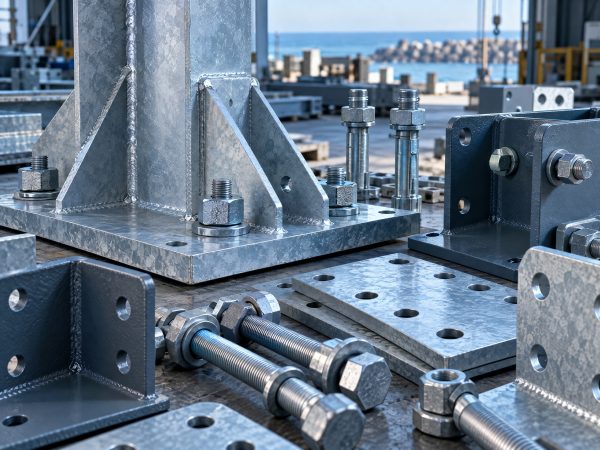
In coastal environments, corrosion protection must extend from the main frame to the smallest connection components.
7. Climate Resilience Starts Before the Container Leaves China
For a remote island project, fixing a problem after shipment can be expensive.
Imagine discovering that several connection components are missing after the container has already arrived on an island.
The problem is no longer simply a factory issue.
It may involve:
Additional production → international shipping → customs → inland transportation → site delay
That is why quality control before shipment is extremely important.
At Island Steel, our inspection process can include:
Material Verification → Product Inspection → Batch Sampling → Quantity Checking → Surface Treatment Inspection → Packaging → Shipment
The goal is simple:
Identify problems before the products leave the factory — not after they arrive at the construction site.
8. El Niño Is a Reminder: Build for the Destination, Not Just the Drawing
A building design should never exist independently from its environment.
A steel structure designed for an inland location may face very different conditions from one built beside the ocean.
For island and coastal projects, engineers and project owners should consider questions such as:
What is the local wind design requirement?
What are the expected wind pressures and uplift forces?
How close is the building to the sea?
What level of corrosion exposure should be expected?
How will the steel connections be protected?
How are anchor bolts connected to the foundation?
What happens if maintenance access is limited?
These questions become even more important when extreme weather and climate variability are part of the project’s long-term operating environment.
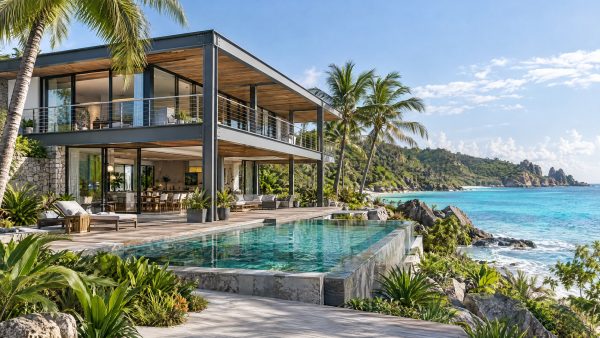
Designed for the destination: modern steel buildings engineered for island and coastal environments.
9. From El Niño to the Future of Island Construction
The 2026 El Niño event is not simply another weather story.
It is part of a larger conversation about how infrastructure should respond to changing environmental risks.
WMO’s latest outlook indicates that El Niño is expected to continue influencing temperature and rainfall patterns into early 2027.
For island nations and coastal communities, this raises an important question:
Are we still building only for today’s conditions?
Or are we building for the conditions a building may experience over the next 20, 30 or 50 years?
The answer can influence everything from material selection to structural design and corrosion protection.
10. Island Steel: Building for Wind, Salt and the Future
En __AITC_0__, our focus is not simply exporting steel components.
Our focus is providing prefabricated steel structure solutions for island and coastal environments.
We pay particular attention to:
Wind-Proofing
Structural systems designed with wind loads, connections and anchoring in mind.
Anti-Corrosion
Protection strategies designed around humid and marine environments.
Material Verification
Checking actual materials and components rather than relying only on appearance or paperwork.
Connection Quality
High-strength bolts, anchor bolts and connection components are treated as critical parts of the structural system.
Factory Quality Control
Inspection before products are packed and shipped overseas.
Prefabricated Construction
Manufacturing major components in the factory before transportation to the project location.
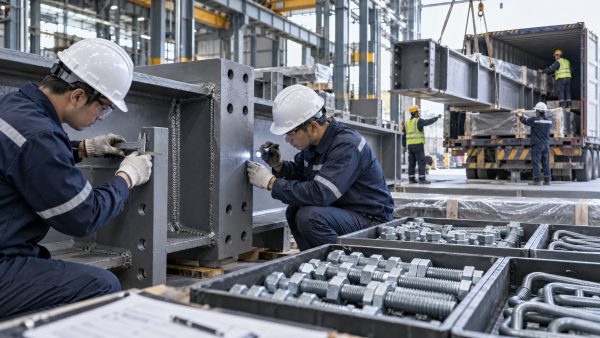
Quality starts in the factory — long before the steel structure reaches the island.
11. The Real Lesson of Super El Niño 2026
The biggest lesson may not be about El Niño itself.
It is about preparedness.
Climate conditions can change.
Storm patterns can change.
Rainfall can change.
Coastal environments can become more demanding.
But a building can be designed with these challenges in mind.
For island and coastal construction, this means thinking beyond the appearance of the finished building.
It means asking:
Can the structure withstand the expected wind loads?
Can the materials handle the local environment?
Are the connections reliable?
Is corrosion protection appropriate?
Can the building be efficiently manufactured, shipped and installed?
These are the questions that turn a building from simply “prefabricated” into a climate-conscious building solution.
Stronger Buildings. Safer Islands.
The strengthening 2026 El Niño is another reminder that environmental conditions should be considered before construction begins — especially for island and coastal projects.
For these environments, wind-proofing and anti-corrosion protection are not just selling points. They are fundamental considerations for long-term building performance.
At Island Steel, we believe that quality begins with every component.
From the main steel frame to the smallest bolt.
From material verification to surface treatment.
From factory inspection to container loading.
Every component matters.
Every batch matters.
Every project matters.
__AITC_0__
Professional Prefabricated Steel Structure Solutions for Island & Coastal Environments.
Planning an island, coastal or hurricane/cyclone-prone project?
Send us your site plan, architectural drawings or preliminary layout.
Our team can review the project requirements and discuss a suitable steel structure solution for your location.
Preguntas frecuentes
¿Cuál es el impacto de El Niño 2026 en edificios insulares y costeros?
El Niño puede influir en la temperatura global, las precipitaciones y los patrones climáticos regionales. Para edificios insulares y costeros, los propietarios de proyectos deben considerar riesgos potenciales como calor extremo, lluvias intensas, inundaciones y condiciones de tormenta cambiantes. Un diseño estructural adecuado, cálculos de carga de viento y protección anticorrosión pueden ayudar a mejorar la resiliencia de los edificios.
¿Cómo pueden diseñarse edificios de estructura de acero para vientos fuertes, ciclones y huracanes?
Los edificios de acero resistentes al viento requieren más que elementos de acero resistentes. El diseño debe considerar las velocidades del viento locales, las presiones de diseño del viento, el levantamiento del techo, el arriostramiento estructural, la resistencia de las conexiones, los pernos de anclaje y el anclaje de la cimentación. Island Steel puede desarrollar soluciones de estructura de acero específicas para cada proyecto según la ubicación, los planos y los requisitos de diseño aplicables.
¿Cómo se protegen las estructuras de acero de la corrosión en zonas costeras?
Las estructuras de acero costeras necesitan protección anticorrosión adecuada a sus condiciones de exposición, incluida la humedad, la niebla salina y la distancia al mar. Según el proyecto, las opciones de protección pueden incluir galvanizado por inmersión en caliente, recubrimientos protectores adecuados y tratamiento Dacromet para componentes aplicables. El sistema adecuado debe seleccionarse según el componente, las especificaciones del proyecto y el entorno de servicio esperado.
¿Cómo puedo obtener una cotización para un proyecto de estructura de acero costera?
Para recibir una cotización específica para su proyecto de Island Steel, proporcione la ubicación del proyecto, planos arquitectónicos o diseño preliminar, dimensiones del edificio, uso previsto y cualquier requisito conocido de carga de viento o protección contra la corrosión. Nuestro equipo puede revisar su información y discutir una solución de estructura de acero prefabricada adecuada para su proyecto.


 09 de octubre de 2026