As climate risks increase, the future of construction is not only about building faster — it is about building smarter, stronger and more resilient.
In 2026, the global construction industry is facing a broader question: How can we build today while preparing for the environmental challenges of tomorrow?
This question will receive further international attention at COP31, taking place in Antalya, Türkiye, from November 9–20, 2026. The COP31 Presidency has identified resilient cities as one of its key action priorities, including a target to reduce energy consumption intensity in the building sector by at least 25% by 2035.
For the construction industry, this is more than a climate discussion.
It is a reminder that the buildings we design and construct today must be prepared for the conditions they may face for decades.
For coastal regions, island nations, tropical markets and rapidly developing areas, this challenge is especially important.
And this is where well-engineered steel structures can play an important role.
Building for More Challenging Environments
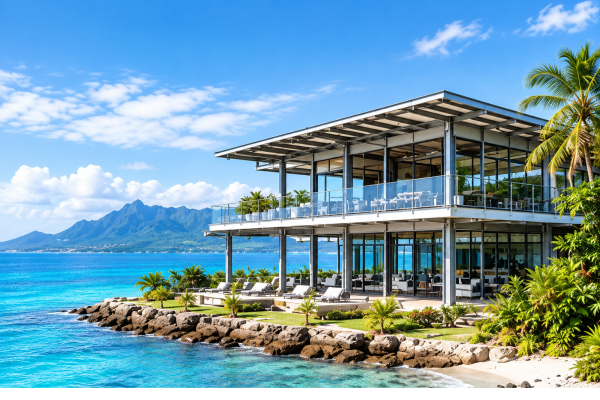
A building is never separated from its environment.
A warehouse in an inland industrial zone may face very different conditions from a villa near the ocean.
A public building in a tropical region may need to consider heavy rainfall and strong winds.
A remote island project may face additional challenges in transportation, construction time, material availability and on-site labor.
These differences mean that there is no single building solution suitable for every location.
The structural system, materials, connections, protective treatments and construction method should all be considered according to the actual project conditions.
At Island (Qingdao) Steel Building Co., Ltd., this principle is at the center of our approach to international steel building projects.
We do not see steel structures as simply a collection of beams and columns. We see them as part of a complete building solution designed around the project.
Why Steel Structures Are Relevant to Climate-Resilient Construction
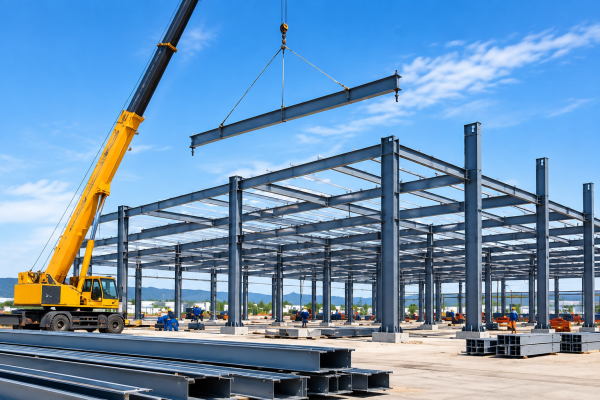
Steel construction has several characteristics that make it suitable for a wide range of modern building applications.
1. Engineered Structural Performance
Steel structures can be engineered according to the loads and environmental conditions of a specific project.
Wind loads, building dimensions, structural spans, connection requirements and other engineering parameters can be considered during the design stage.
For projects in areas exposed to strong winds or tropical weather, structural design should be developed according to local codes and project-specific engineering requirements rather than relying on a standard building model.
This is particularly important for coastal and island developments.
The goal is not simply to use “stronger steel.”
The goal is to create an appropriate structural system.
2. Protection Against Corrosive Environments
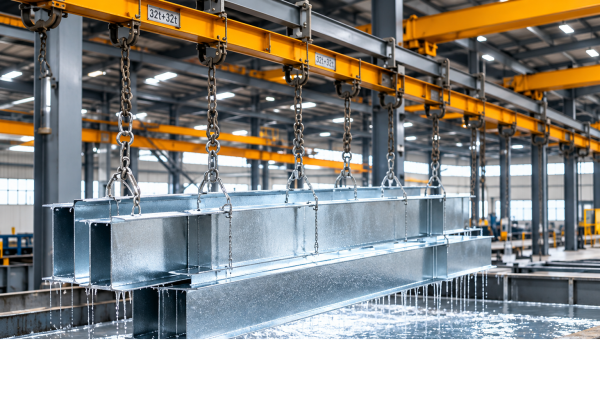
For coastal construction, durability is closely connected to corrosion protection.
Salt-laden air, humidity and moisture can accelerate corrosion if steel components are not properly protected.
This makes surface treatment an important part of steel building design.
Depending on the project environment and required service conditions, steel components may use protection systems such as hot-dip galvanizing, protective coatings or other specified anti-corrosion treatments.
The appropriate solution should be determined according to factors such as exposure conditions, maintenance requirements, coating specifications and the expected service environment.
For Island Steel, corrosion protection is particularly relevant to the island and coastal projects we serve.
The structure should not only be designed for today. It should be prepared for the environment in which it will operate.
3. Faster and More Organized Construction
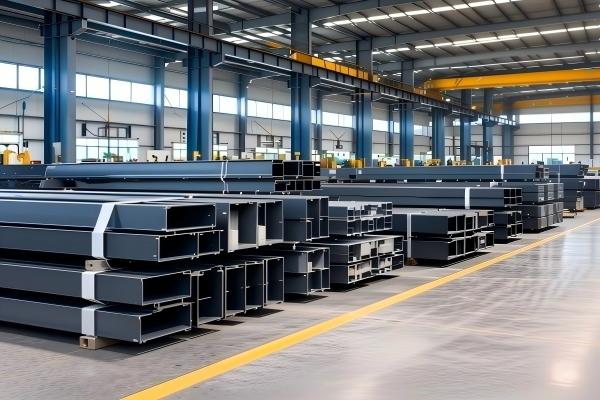
Climate resilience is not only about the finished building.
It is also about how efficiently the building can be delivered.
Traditional construction can require large quantities of materials, extensive on-site processes and significant coordination between different trades.
Prefabricated steel construction moves a significant part of the production process into a controlled factory environment.
Steel components can be fabricated, inspected, organized and prepared for transportation before arriving at the project site.
This approach can help create a more structured construction process, particularly for projects where site access, construction time or local labor availability presents a challenge.
For remote island projects, this can be particularly valuable.
The more work that can be accurately prepared before reaching the site, the more predictable the construction process can become.
4. A Practical Solution for Remote and Island Projects
Island and coastal developments often require a different approach to construction.
Materials may need to travel long distances.
Construction sites may have limited storage space.
Local labor and equipment may not always be readily available.
Weather conditions can also affect construction schedules.
For these projects, prefabricated steel components offer a practical way to move part of the construction process from the site to the factory.
The components can then be packed, loaded into containers and transported to the destination for assembly.
This factory-to-site approach can be adapted for different building types, including:
The exact solution depends on the project’s architectural design, structural requirements, local regulations and site conditions.
Resilience Requires More Than One Material
It is important to understand that steel alone does not make a building climate-resilient.
A resilient building is the result of multiple decisions working together.
Structural design matters.
Foundation design matters.
Connections matter.
Roof and wall systems matter.
Drainage matters.
Corrosion protection matters.
Local building codes matter.
And, most importantly, the entire system must be designed according to the actual environment.
This is why we believe responsible steel construction should begin with understanding the project — not simply selecting a standard product.
For example, a coastal villa, an industrial warehouse and a public building may all use steel structures, but their design requirements can be completely different.
Good engineering starts with the right questions.
Where is the project located?
What are the local wind conditions?
What is the site environment?
What building function is required?
What are the dimensions and spans?
What local codes apply?
How will the building be transported and assembled?
What level of corrosion protection is appropriate?
These questions help turn a general building concept into a practical engineering solution.
From Engineering Drawings to a Real Building
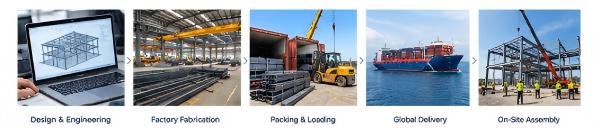
Behind every completed steel building is a long chain of processes.
It starts with an idea.
Then come architectural drawings, structural calculations and engineering coordination.
The steel components are then fabricated in the factory, inspected, organized and prepared for transportation.
After export, the components arrive at the project site and become part of the final structure.
At Island Steel, our role is to support this process from the manufacturing side.
We provide customized steel structure solutions for international projects, working according to the available project information and technical requirements.
Our production scope covers different types of steel building applications, from steel frame villas and public buildings to warehouses, industrial plants and supporting accommodation facilities.
For international customers, we can work from architectural drawings, structural drawings, floor plans, dimensions, 3D models or basic project requirements.
The earlier the technical information is clarified, the easier it becomes to develop a practical solution.
Building for the Future Starts with Better Decisions Today
The global construction industry is entering a period in which resilience, efficiency and responsible resource use are becoming increasingly important.
UNEP’s 2025–2026 Global Status Report for Buildings and Construction highlights the scale of this challenge: buildings and construction account for a significant share of global economic activity, employment, emissions and material extraction, while a large portion of the buildings that will exist in 2050 have yet to be built or renovated.
That means today’s construction decisions will influence the built environment for decades.
For developers, contractors, architects and building owners, the question is therefore not simply:
“What can we build?”
It is:
“How should we build it for the environment, requirements and future of the project?”
At Island Steel, we believe steel construction can be part of that answer — when it is properly engineered, appropriately protected and carefully integrated into the overall building system.
From factory fabrication in China to projects around the world, our goal is simple:
To provide practical, customized steel structure solutions for the way people will build tomorrow.
Your Project. Our Steel. Built for the World.
Whether you are planning a coastal villa, island resort, warehouse, industrial plant, public building, staff accommodation or multi-story project, the first step is understanding your requirements.
Send us your:
Architectural drawings | Structural drawings | Dimensions | Floor plans | 3D models | Project requirements
Our team can review your information and discuss a suitable steel structure solution for your project.
Island (Qingdao) Steel Building Co., Ltd.
Engineering. Fabrication. Export. Global Steel Building Solutions.
Your Project. Our Steel. Built for the World.
FAQ
What are climate-resilient steel structures?
Climate-resilient steel structures are buildings engineered to respond to the environmental conditions of their location, including wind, humidity, corrosion exposure and other project-specific requirements. Structural design, connections, foundations and protective systems should be considered together.
Are steel structures suitable for coastal and island environments?
Yes. Steel structures can be designed for coastal and island projects when appropriate structural engineering and corrosion protection systems are applied. Project location, wind conditions, humidity, salt exposure and local building requirements should be considered during design.
How can steel structures help speed up construction?
Many steel components can be fabricated and prepared in a controlled factory environment before being transported to the construction site. This can help reduce on-site fabrication work and create a more organized installation process.
How are steel structures protected against corrosion?
Depending on the project environment and specifications, steel components can use protection systems such as hot-dip galvanizing, protective coatings or other specified anti-corrosion treatments. The appropriate system should be selected according to the project's exposure conditions and requirements.
What information is needed for a steel structure quotation?
Customers can provide architectural drawings, structural drawings, floor plans, dimensions, 3D models or basic project requirements. Our team can review the available information and discuss a suitable steel structure solution for the project.


 September 21, 2026